
Why All the Fuss About F1 Tyres? — The Complete Beginner's Guide
If you've ever watched an F1 broadcast, you've probably noticed the commentators constantly talking about tyres. "They've gone onto softs", "will the mediums hold up?", "degradation is kicking in"... If you're new to F1, you might wonder — are tyres really that important? The short answer: tyres are one of the single most important factors in Formula 1.
Today, let's break down everything a beginner needs to know about F1 tyres.
Why Are Tyres So Important?
An F1 car produces around 1,000 horsepower, but all that power is transmitted to the track through just four tyres. No matter how powerful the engine, if the tyres can't grip the road, it's all for nothing.
Think of it like running shoes. Even the fastest sprinter can't perform on an ice rink wearing dress shoes, right? Similarly, F1 teams need to choose the right "shoes" for each circuit's characteristics, temperature, and surface conditions.
Here's the key twist: unlike regular road car tyres that last around 80,000 km, F1 tyres are deliberately designed not to last an entire race. They're made to wear out. Why? Because tyre wear forces pit stops, pit stops create strategy, and strategy creates dramatic comebacks and overtakes.
Soft, Medium, Hard — Three Colours Explained
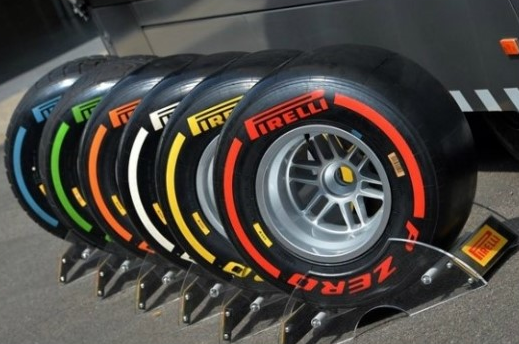
During a race, you'll notice tyres marked with red, yellow, or white sidewall stripes:
- 🔴 Soft — Red
- 🟡 Medium — Yellow
- ⚪ Hard — White
It's quite intuitive:
Soft tyres are the grippiest and produce the fastest lap times, but they wear out quickly — like pressing an eraser hard against paper.
Hard tyres offer less grip but last much longer, ideal for extended stints during a race.
Medium tyres strike a balance between speed and durability — the all-rounder that's often the most popular choice in races.
| Type | Grip | Durability | Lap Time | Best For |
|---|---|---|---|---|
| 🔴 Soft | ★★★ | ★ | Fastest | Qualifying, short stints |
| 🟡 Medium | ★★ | ★★ | Middle | Primary race tyre |
| ⚪ Hard | ★ | ★★★ | Slowest | Long stints, endurance |
So What Are C1, C2, C3...?
This is where many beginners get confused. "Isn't soft, medium, hard enough?" Well, there's a more detailed system behind those labels.
F1's tyre supplier Pirelli produces six dry tyre compounds for the entire season, labelled C1 through C6 (C6 was added from the 2025 season):
- C1: Hardest (slowest but most durable)
- C2: Hard
- C3: Medium
- C4: Soft-ish
- C5: Very soft
- C6: Softest (fastest but least durable) — New for 2025
For each Grand Prix, Pirelli selects three of these six to be that weekend's tyres.
For example:
Suzuka (Japanese GP) — High-speed corners, extremely demanding on tyres → C1 (Hard), C2 (Medium), C3 (Soft)
Monaco GP — Low-speed street circuit, gentle on tyres → C4 (Hard), C5 (Medium), C6 (Soft)
So the "Soft" tyre at Suzuka is C3, while at Monaco it's C6. Same name, completely different tyre. Understanding this is the key to following tyre commentary.
Think of C-numbers as the actual model name of the shoe, while Soft/Medium/Hard are just relative nicknames given for each weekend.
What About Rain? — Wet Tyres and Intermediates
Beyond dry tyres, there are two wet-weather options:
- 🟢 Intermediate — Green: For damp tracks with light water. Has grooved tread to disperse water.
- 🔵 Full Wet — Blue: For heavy rain with standing water. Deep grooves to clear large volumes of water.
Unlike dry tyres, wet compounds remain the same all season — no C-numbering system. Rain means intermediates; heavy rain means full wets. Simple.
Some of F1's most dramatic moments come from tyre choice during rain: "Do we switch to inters now, or stay on wets?" — one call that can completely change the race result.
How Many Tyres Do Drivers Get Per Weekend?
F1 regulations strictly limit how many tyre sets each driver can use:
Standard Grand Prix Weekend: - 2 sets of Hards, 3 Mediums, 8 Softs = 13 sets total - Plus 4 Intermediates, 3 Full Wets
Sprint Weekend: - 2 sets of Hards, 4 Mediums, 6 Softs = 12 sets total - Plus 5 Intermediates, 2 Full Wets
Crucially, drivers must return some tyre sets after each practice session. Teams must carefully plan which tyres to use during practice, saving their best sets for qualifying and the race.
Drivers who reach Q3 (the final qualifying round) must use a mandatory set of soft tyres — which is then returned afterward. This means the top 10 qualifiers have one fewer fresh set of softs available for the race.
Race Day Tyre Rules: Minimum Two Compounds
F1 regulations require drivers to use at least two different dry compounds during a dry race. This means zero-stop races are impossible in dry conditions.
This rule forces at least one pit stop, creating strategic crossroads: - One-stop strategy: Pit once, conserve tyres, maintain track position - Two-stop strategy: Pit twice, push harder on fresher rubber each stint
Which approach works best depends on the circuit, weather, and degradation levels. This is the heart of F1 strategy.
From the 2025 Monaco GP, a special regulation even introduced mandatory two pit stops to encourage more varied strategies at a circuit famously difficult for overtaking.
The Key to Tyre Management — "Working Range"
Every tyre has an optimal operating temperature (working range). Within this window, grip is maximised. Outside it, performance drops dramatically.
- Too cold: Rubber stiffens, grip disappears → sliding and instability
- Too hot: Rubber melts away rapidly → accelerated wear and performance loss
That's why teams use tyre blankets — electric heating wraps that warm tyres to 70°C before they go on the car. This ensures optimal grip immediately out of the pits.
Ever noticed drivers weaving their cars side to side on the formation lap? That's not showing off — it's generating heat in the tyres. Cold tyres mean no grip, which means potential disaster at Turn 1.
Softer compounds work best at lower temperatures, while harder compounds need more heat to reach their peak. This affects strategy too — on cold days, hard tyres may never reach their working range.
Essential Tyre Terminology
Here are the key terms you'll hear during any F1 broadcast:
Degradation ("Deg")
The gradual loss of tyre performance due to heat and friction over time. "High deg" means tyres are losing performance quickly, potentially favouring a two-stop strategy.
Graining
When the tyre surface is too cold or slides excessively, small rubber particles tear away and re-stick to the surface, creating an uneven, grainy texture that reduces grip. Think of it like eraser shavings clumping on paper.
The good news: graining is temporary. With continued driving, the irregular layer wears away, revealing fresh rubber underneath. Skilled drivers can work through it faster.
Blistering
Occurs when the tyre's interior overheats. Heat gets trapped inside the rubber, causing bubbles that burst and rip chunks away from the surface — like pizza dough blistering in an oven that's too hot.
Unlike graining, blistering is irreversible damage. Once it starts, a pit stop usually becomes unavoidable.
Cliff
A sudden, dramatic drop in tyre performance. Rather than a gradual decline, the tyre falls off a "cliff" — losing grip almost instantly. When a driver hits the cliff, an immediate pit stop is essential.
Undercut & Overcut
Strategy terms closely tied to tyres: - Undercut: Pitting before the car ahead, using fresh tyre grip to overtake when they're still on worn rubber. Powerful at high-degradation circuits. - Overcut: Pitting later than rivals, exploiting track position while they warm up new tyres.
Marbles
Rubber debris that falls off tyres during a race and accumulates off the racing line. Driving over marbles is like driving on gravel — instant grip loss. That's why drivers stick to the racing line wherever possible.
2025 Season Tyre Data
The most-used compounds across the entire 2025 season:
- C3 — ~93,500 km (most versatile)
- C4 — ~91,600 km
- C5 — ~66,300 km
- C2 — ~35,000 km
- C6 — ~22,400 km
- C1 — ~17,400 km
C3 and C4 were the real workhorses, while the hardest C1 was used sparingly — mainly at extreme circuits like Suzuka.
The longest single stint of the season was set by Haas driver Esteban Ocon, who completed 49 laps (~303 km) on a single set of C3 tyres in Jeddah. When you consider road tyres last tens of thousands of kilometres, the extreme environment of F1 really comes into perspective.
Understanding Tyres Makes F1 10x More Fun
At first, just knowing "red, yellow, white" is enough. But with a bit more knowledge, broadcasts become a completely different experience.
"They went on hards instead of mediums!" → The team is going for a one-stop strategy.
"Softs are degrading after just 10 laps" → A pit stop is coming soon.
"C3 is this weekend's soft" → This is a tough circuit, expect conservative strategies.
When these thoughts start coming naturally, you're already enjoying F1's strategy game. 🏎️
Discover more F1 beginner guides at F1MOA!
No comments yet. Be the first!